


-1-1600x1065.jpg&w=3840&q=75)
The PPWR reshapes EU packaging rules through prevention, reuse, recyclability and producer responsibility from August 2026.
Overview
The Packaging and Packaging Waste Regulation, commonly known as the PPWR, began to apply across the European Union on 12 August 2026. It covers all packaging and packaging waste, regardless of material or origin, from production and use to end-of-life management. Its purpose is not simply to improve recycling: it is to prevent unnecessary packaging, increase reuse and refill, and keep materials circulating for longer. Because design determines what enters the market and what can be recovered afterwards, packaging decisions affect the entire value chain.
One regulation, multiple changes
The PPWR replaces a fragmented landscape with a common framework for packaging placed on the EU market. Compliant packaging can circulate freely across Member States, which generally cannot impose conflicting national requirements unless the regulation provides otherwise. Alongside harmonising the market, the framework aims to reduce packaging waste and support a circular economy compatible with EU climate-neutrality goals for 2050.
Design and materials
The regulation starts upstream, before packaging becomes waste. Packaging must minimise harmful substances and use no more weight and volume than necessary. Extra material cannot be justified only by marketing or consumer acceptance. Formats designed to make a product appear larger through false bottoms or double walls are prohibited, subject to specific design or trademark protections.
Recyclability also becomes a design requirement. Packaging must be designed for material recycling and, from 2035, capable of being collected, sorted and recycled at scale. Performance grades will apply from 2030, followed by stricter requirements from 2038. Plastic packaging must contain minimum levels of material obtained from post-consumer plastic waste (plastic discarded after use), with exemptions for specified categories.
Less empty space
The PPWR directly addresses avoidable volume. By 2030, grouped, transport and e-commerce packaging filled by economic operators may contain no more than 50% empty space. Sales packaging must also minimise empty space while preserving its function.
From the same year, several single-use plastic formats will be restricted. These include some films used to group products at the point of sale, packs for less than 1.5 kg of fruit and vegetables, individual condiment portions, small hotel toiletries and most very lightweight plastic bags. Exemptions remain, so the rules do not create a blanket ban on every use.
Reuse and refill
The regulation treats reuse as a system, not just a packaging characteristic. Reusable packaging must withstand multiple rotations, remain safe, hygienic and recyclable, and allow refilling and labelling without affecting product quality. Businesses must also ensure collection, reuse and reconditioning before another rotation.
Targets begin to reshape distribution models from 2030. By then, 40% of transport packaging and 10% of grouped packaging must be reusable. Beverage distributors must ensure that 10% of products are supplied in reusable packaging. Aspirational targets for 2040 rise to 70%, 25% and 40%, respectively, with exemptions for specified businesses, sectors and geographic conditions. Takeaway businesses face an earlier transition: customers must be allowed to bring their own containers at no extra cost by 2027, and reusable takeaway packaging must be offered without an additional charge by 2028.
Shared responsibility
The PPWR distributes responsibility across the supply chain. Under extended producer responsibility, producers must cover the necessary costs of collection, sorting and recycling. Modulated fees (charges adjusted according to environmental performance) are intended to reward eco-design and recyclability.
Manufacturers must assess conformity, issue an EU declaration of conformity and retain technical documentation for five years, or ten years for reusable packaging. Importers and distributors have verification duties, while suppliers must provide the information needed to prove compliance. Waste management operators must report packaging waste data annually. Member States must provide collection, sorting and recycling infrastructure and establish deposit-return systems for single-use plastic or metal beverage containers by 2029 unless high collection rates have already been achieved.
Beyond the value chain
The PPWR requires companies to work within the packaging value chain, from material selection and design to reuse, recycling and end-of-life management. These upstream and within-value-chain measures are essential to prevent unnecessary packaging, improve circularity and reduce the risk of waste escaping formal collection systems.
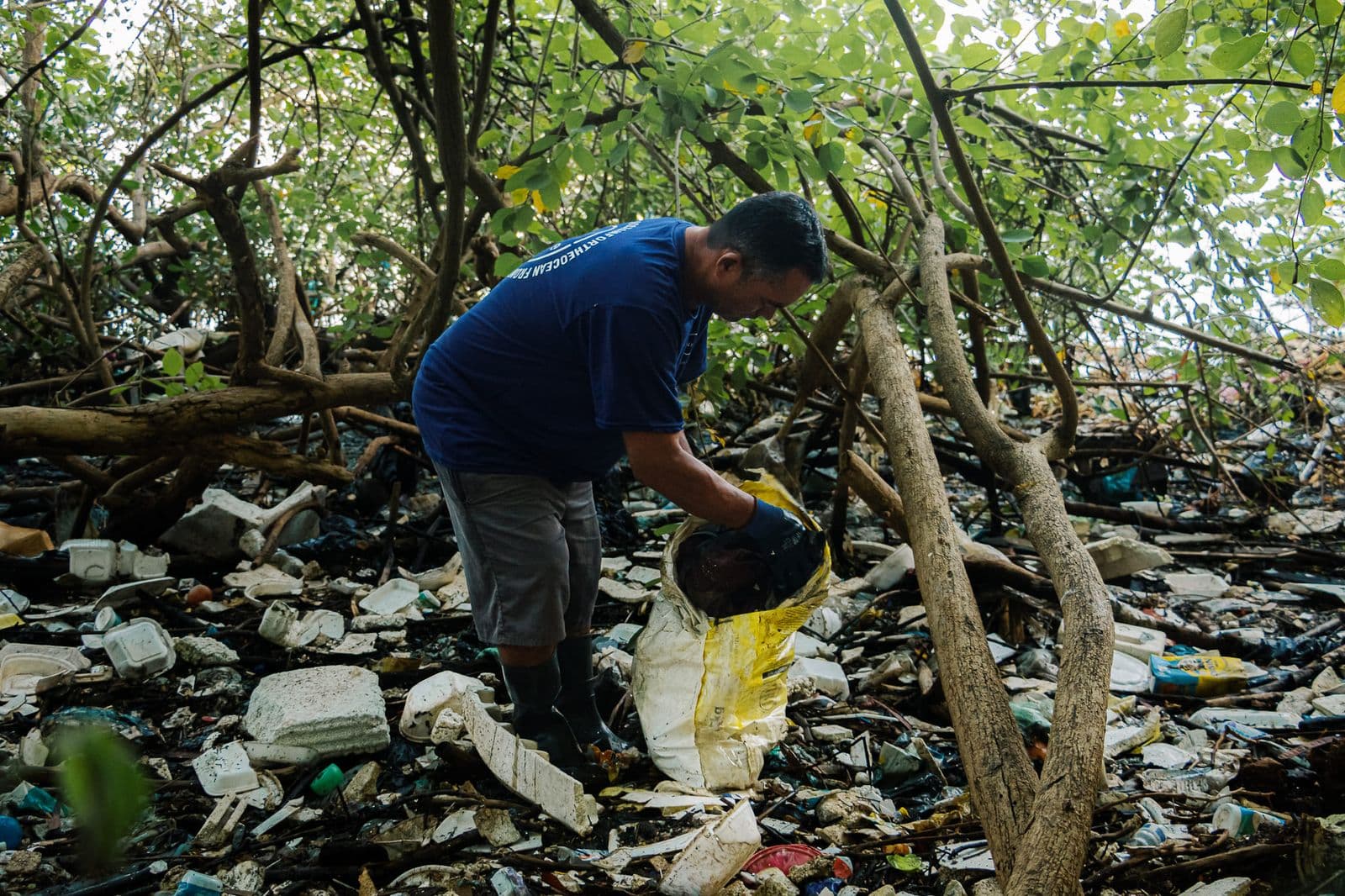
At the same time, environmental responsibility extends beyond the value chain. Packaging waste has already accumulated in marine environments and along coastal areas, where it can harm ecosystems and remain outside formal waste management systems. Collection activities can address this existing pollution and help intercept waste before it reaches the Ocean. They do not replace packaging reduction, reusable systems, recycled content, extended producer responsibility or any other PPWR obligation; they complement them by responding to impacts that have already occurred are estimated to progressively get worse.
Ogyre illustrates this beyond-the-value-chain approach. It works with local fishers in Italy, Brazil, Indonesia and Senegal to collect litter from marine environments and intercept waste along coastal areas. The collected materials are transferred to local cooperatives for sorting, recycling where possible or responsible disposal, while activities are tracked through blockchain technology to preserve traceability and data integrity.
This distinction is essential for credible environmental disclosures. PPWR compliance concerns whether packaging placed on the EU market meets legal design, labelling, reuse and end-of-life requirements. Documented ocean cleanup activities concern a separate intervention beyond the value chain, after leakage has occurred or where pollution is already present. Reporting the two accurately shows how companies can act both within the value chain, by improving packaging systems, and beyond it, by helping address existing environmental damage.
From packaging to systems
The PPWR changes the unit of attention from the individual pack to the system around it. Less material must be used at the design stage; reusable packaging requires collection and reconditioning; recycling depends on sorting capacity and viable markets; and producer responsibility connects commercial choices to end-of-life costs.
Its application from 12 August 2026 is only the beginning of a phased transition, with major requirements taking effect in 2027, 2028, 2029, 2030, 2035 and 2038. The direction is already clear: prevent unnecessary packaging first, keep packaging in use where possible, and design the remaining material so that it can be recovered at scale. Marine and coastal recovery remains necessary for waste already outside those systems, but lasting progress depends on preventing that leakage at its source.
![[object Object]](/_next/image?url=https%3A%2F%2Fogyre.fra1.cdn.digitaloceanspaces.com%2FDSC_5208%20(1)-compressed-1600x1065.jpg&w=3840&q=75)
![[object Object]](/_next/image?url=https%3A%2F%2Fogyre.fra1.cdn.digitaloceanspaces.com%2FOgyre%20-%20Wiliam%20Alves3843%20(1)-1600x1066.jpg&w=3840&q=75)
![[object Object]](/_next/image?url=https%3A%2F%2Fogyre.fra1.cdn.digitaloceanspaces.com%2Findo%20warehouse%20(1)-1600x1065.jpg&w=3840&q=75)